Desk Accessories · Review
Logitech G Yeti GX
A plug-and-play dynamic USB mic with a supercardioid pattern, Smart Audio Lock, and RGB that rejects keyboard noise far better than the original Yeti.
Published
Our verdict
4.2 / 5
Price at time of review
$159.64
Prices change. As an affiliate, we earn from qualifying purchases — it never decides the verdict.
What we like
- Dynamic supercardioid capsule ignores key clicks and room noise much better than a condenser Yeti
- Smart Audio Lock uses an analog limiter and downward expander to catch clipping and ambient noise
- Blue VO!CE filters and effects in G HUB add broadcast-style processing without extra gear
- Plug-and-play USB with dual-zone LIGHTSYNC RGB that syncs with other Logitech G gear
- Cheaper than the Shure MV7+ at $249
Could be better
- USB only, with no XLR output, so there's no upgrade path to an audio interface
- Sound is clean but can feel a little flat and less dimensional than pricier dynamic mics
- Best features depend on G HUB software, which some people find heavy
- RGB and gamer styling won't suit a minimalist desk
Full Review
Build and Design
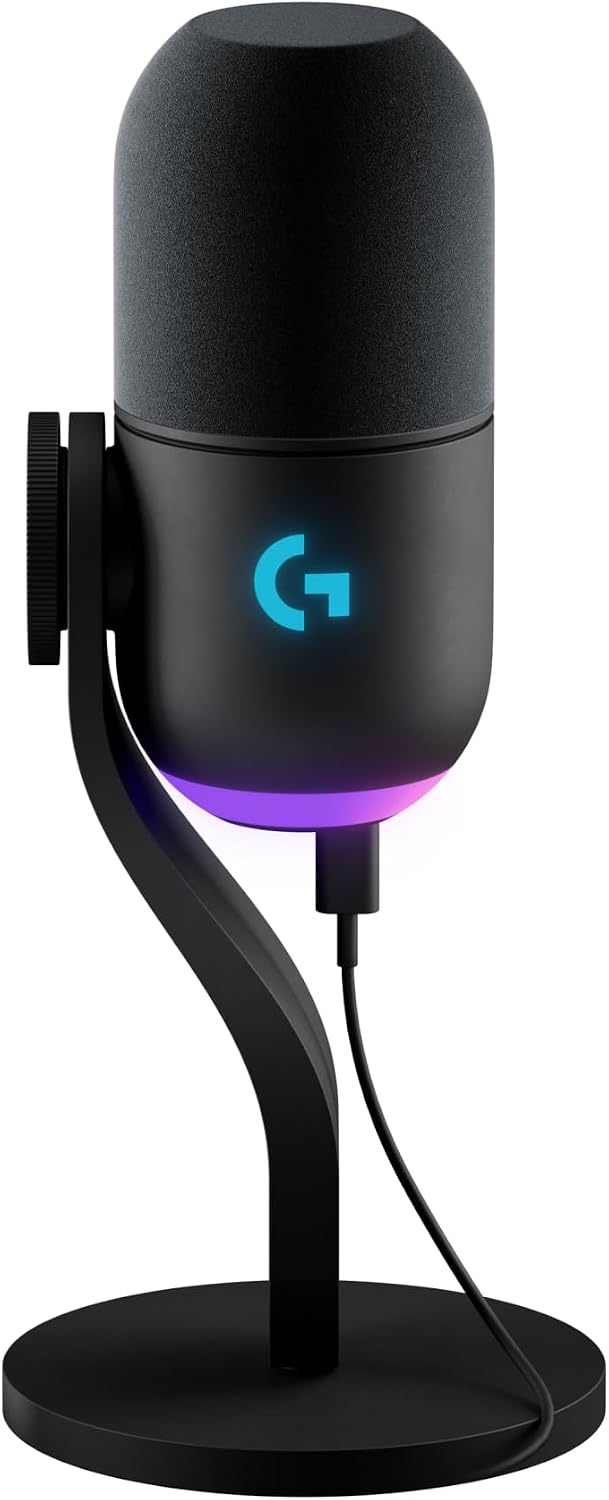
The Yeti GX keeps the Yeti name but swaps in a broadcast-style dynamic capsule. It has the bold, clean look of Logitech G gear, with two RGB zones. It works on a desk stand, and it also suits a boom arm if you want the mic closer to your mouth and off the desk.
Key Features
The main upgrade is the capsule. A dynamic, supercardioid design focuses on what’s directly in front of it. That means keyboard clicks, fans, and room echo get pushed back much more than with the condenser in the original Blue Yeti.
Smart Audio Lock adds an analog limiter to catch sudden loud moments, plus a downward expander that reduces ambient noise between words. In G HUB you can add Blue VO!CE filters, effects, and samples. That gives you EQ, compression, and de-essing without an outside mixer. The LIGHTSYNC lighting is controlled from the same app and can match other Logitech G gear.
Daily Use
Plug it in and it works. Sit close, speak at a normal volume, and the voice comes through clean and controlled. Keystrokes and mouse clicks fade into the background in a way a condenser can’t match.
The tone is competent rather than exciting. It can sound a bit flat next to the Shure MV7+, which costs $249 and gives you better dimension and an XLR route for later. If you want a studio-grade voice and might outgrow USB, consider the Shure instead.
If you want a more streamer-focused competitor, the HyperX QuadCast 2 is the obvious one to compare. It’s worth shopping both if RGB and a gamer-first feature set matter most to you. If you’d rather have a simpler, more neutral-looking desk mic, the Elgato Wave:3 is another option.
At $159.64, the Yeti GX sits in the middle of the price range. You get real noise rejection and useful onboard processing, but you give up expandability.
Who Should Buy This
Buy it if you stream, game, or record calls on a noisy desk and want a mic that works the moment it’s plugged in. It’s the right pick if you type loudly, don’t have a treated room, and like the RGB look.
Skip it if you want XLR flexibility, the most natural voice reproduction, or a quiet, understated look. In that case, the Shure MV7+ is the better long-term buy. If you only need a basic mic and don’t care about noise rejection, a cheaper option will do.